
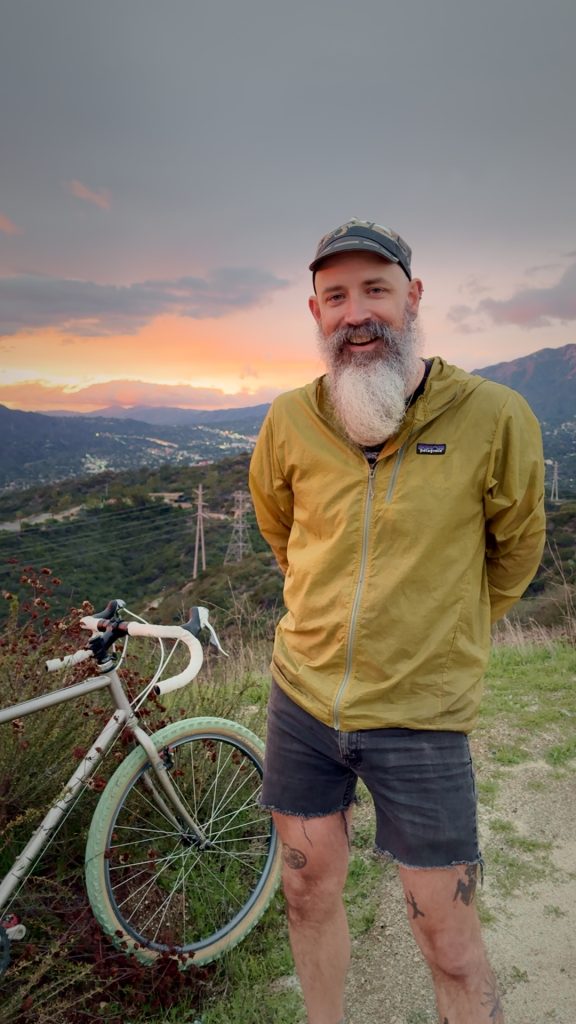
Congratulations Ben on achieving 2X Mountain Goat on November 22, 2025. Ben was one of eight SOTA activators who accompanied Josh WU7H, as he visited from the Pacific Northwest and activated W6/CT-226 Flint Peak and W6/CT-226 Cerro Negro. On this day Ben rode his bicycle from Los Angeles to the two peaks, then back home again following a celebratory dinner at Los Gringos in La Canada. Ben achieved 2X on the same peak, Cerro Negro, as on his first SOTA activation which was made six years earlier.
Ben is an active and well-known member of the SoCalSOTA community. He has made 391 activations on 206 unique summits, achieving his first W6 SOTA Mountain Goat award, #28 of 48, on March 2023. Those of us seeking information on summit hikes typically go to sotadata.org.uk to look up trip reports. Ben has contributed to this archive by pointing the reader to his WordPress blog, blog.benmook.com. Here you will find information not only on trail conditions, but also follow his adventures activating with Moto, his dirt bike.

Some SOTA members are fortunate to own a custom, event-designed silk-screen shirt. Ben creates a new design, specific to each event, turns it into a stencil, then brings it along with ink and silk-screen frame to SOTA camp-outs and other events. The recipient brings their own shirt, has Ben do the silk-screen imprint, and leaves with a souvenir of the event.
Here is more about Ben's introduction to ham radio, in his own words.
Grandpa’s shack
In the late '80s, our family would travel across our home state in a 1984 Ford Crown Victoria to visit my grandparents, about 150 miles away once or twice a year. My grandfather Ken (SK) was an Air Force veteran of WWII, a retired high school teacher, instructor at a vocational technical school, and an avid amateur radio operator. A room in their home was the “shack” which housed shelves of curiosities; home built equipment, old radios, modern radios, cables—everywhere, and of course, that smell of old hot electronics. There was an Apple II and a teletype connected to HF radios, while a dot matrix printer clacked out RTTY nets late into the evening against the static of a noisy band.
As a little kid, I was too young to really understand all this stuff, but that didn’t stop Ken from supplying me with various cardboard slide rules. One would calculate resistor values based on color codes, another would describe the relationship between voltage, current, and resistance in an electrical circuit. There were more, but I can’t remember what they were. Additionally, he built me a code oscillator and gave me a straight key screwed to an old piece of wood. We would practice sending letters over and over but honestly none of this really stuck. Or did it?
Fast forward to sometime in 2004—I read that morse code wasn’t required to obtain a license anymore. Excited about the prospect, I found an opportunity to take the Technician test in just a few days' time. Of course, I didn’t buy a book, or study, or put much effort into doing anything other than showing up to a random restaurant in Orange County on a weekday with a number 2 pencil and $15. Being so unprepared, I obviously failed the test—not once, but twice! Defeated, I bought a Technician study guide, read through it a few times, shopped for a basic FM radio and decided I didn’t want to spend the money on equipment. I shelved the book along with the idea of becoming an operator.
One evening while sitting in a cocktail bar in early 2015, a friend reached into their bag, pulled out a Baofeng and set it on the table saying, “These are cheap now”. That simple moment ignited a new interest in getting involved with the hobby, as one didn't need to shell out $200 for a basic radio to participate—or even observe what goes on within the VHF/ UHF bands. I soon found myself scouring the internet in search of information; where repeaters were located, what various simplex nets were all about, that AX.25 has been in the Linux kernel since 1999. Before a long flight home from São Paulo, I ordered my very own Baofeng and studied on the flight for the technician exam, which I took—and passed the very next day at a hospital in Van Nuys. The only thing left to do was wait for my new FCC call sign.
I spent a couple of months tinkering with the privileges granted to technicians while exploring various facets of this hobby until one November day in 2015 I decided I should upgrade to general and get access to these HF bands I kept hearing so much about. I studied, took, and passed the general exam in the back room of a random Orange County Marie Callender's at 7am. Now an /AG, I needed equipment to operate on these new bands. A few days later my wife and I found ourselves in a popular radio store in Burbank, just to look around when a Yaesu 857 caught my eye. I'd seen this one online but never in person. I liked the small compact size, the large group of worldwide users, and the availability of various widgets from a spectrum of vendors. I wasn't planning to make a purchase that day, but my wife said, "just buy it", so I did, along with 25 feet of coax.
I live in an old building, in the middle of Los Angeles, and one thing I didn't consider enough before buying the 857 was placement of an HF antenna! There really isn't a good place for one. The front and side of the property is cluttered with power, cable TV, and utility lines. There are no trees on the other side of the house. Putting something in the backyard would require a long run of coax that would run across walkways creating a trip hazard. In fact, at the time of this writing (December 2025) I'm still struggling to come up with a good HF antenna solution for my QTH. Every experimental antenna I've managed to get up just receives S9+20 noise. Because of this, I seriously thought the new 857 I bought was broken. "I should hear something, right?". I almost returned it to the dealer.
My friend group enjoys camping in the Mojave desert of Southern California. After acquiring a tired old deep cycle battery, a magnet mounted 20M ham-stick antenna, I brought the whole setup camping near 29 palms. That's north of Joshua Tree, but south of The Mojave Preserve—better known as "the middle of nowhere". After settling camp for the weekend, my attention turned to this "broken" HF radio I wanted to return. After connecting the battery to the radio, and the radio to the coax feeding the antenna I powered the radio on expecting to hear nothing. Instead, was almost instantly transported back 25 or so years to my grandparents’ house. That sound of a spinning VFO was burned into my brain, and there I was, hearing it again. I could almost smell the hot tubes. I didn't attempt to make my first HF QSO that night—I was too scared, but I was happy the radio was not broken.
It became pretty clear that If I wanted to operate HF, I couldn't do so from home. Going outside, away from high noise and into open space was the only option moving forward. While motorcycling high up in the Angeles National Forest, I discovered a few areas which were favorable for experimenting with simple wire antennas. One spot in particular became a trend; I'd return over and over for various radio activities without space or RF noise limitations. One day I simply brought a 2M HT and decided I would hike up to the remnants of a fire lookout tower, just a few miles above my favorite radio spot in the forest. I figured if there was a fire tower there, it must be high up with a good viewshed, which should get some good contacts on 2m FM. Once there, I started calling CQ and worked several stations below in L.A.. One station called back and said, "Where are you exactly?" "Angeles Forest, Vetter something" I replied, "It used to be an old lookout tower, but it burned down in the 2009 Station Fire" at which point, the station at the other end replied "Oh, that's a SOTA summit, W6/CT-021". I had no idea what any of that meant but my interest was piqued. Technically, this was my first activation, but I didn't know it at the time.
It took about a year after that first mention of the SOTA program to actually figure out what SOTA was, what the rules were, how I could participate, and how to use the tools available online to plan and execute a successful activation. More time than I'd like to admit was spent studying the map database, making mental notes on areas I wanted to visit, and finding opportunities to activate in places I'd been camping for years. I was no longer confined to a specific place in the Angeles Forest—There were new places to go! I picked up a smaller radio that could easily fit inside a backpack and run on rechargeable batteries. Compact antennas built from various kits were assembled, and I upgraded to /AE. With the right tools in a bag, W6/CT-226 (Cerro Negro Benchmark) was activated in October of 2019.
The thrill of an HF pileup and that first point in the SOTA database flipped some kinda switch in my brain that day that's still on six years later. I needed to activate more. Hike farther. Go higher. Explore new terrain. Get uncomfortable. Before I knew it, I found myself in places I never knew existed—right in my own backyard of Southern California. Eventually, the small Yaesu 817 became too large and cumbersome for difficult efforts. It required a microphone and a heavy external battery for extended activations. It took up room in my pack that could otherwise be used for water, food, or additional layers. To facilitate this, I needed to switch modes from SSB to CW, as continuous wave radios are much smaller, more efficient, and lighter than their more complex SSB cousins.
I like to think I started learning CW in 1989 in my grandfather's shack and it took me 35 years to get the code down, but that might be a bit of a stretch. Before getting involved in SOTA I held a job which required frequent international and domestic travel. As such, I had hours of time available with nothing else to do except learn morse code from various phone apps. I mastered these apps quickly and would practice sending at home by reading a book, keying the words on the pages into the CW decoder in FLDigi at around 17 WPM. This turned out to be false confidence, and I quickly realized after a failed QSO that I couldn't copy real QSOs, and I couldn't send unless I was reading it off a paper. The apps were a game and not a real trainer. I needed to do much more work.
Eventually I gained CW confidence and in July 2021 on W6/IN-050 Poverty Hills, I switched modes from SSB to CW and made my first several CW QSOs. From that point I did mixed SSB/ CW activations until I purchased a small CW-only radio which forced me into a single mode. This was great as I could now enjoy a much lighter backpack, which allowed me to hike longer, higher, faster, and with less fatigue—opening up new summits and new opportunities to explore new landscapes. In December of 2023, I activated W6/CT-151 (Frankish Peak) which pushed my points count over 1000, something I never imagined would be possible.
Amateur radio combined with SOTA has been such an enriching experience for me in a couple ways. First there is the technical aspect - understanding and applying theory, building stuff, working with open-source software. Second and most important are the memories made, the friends I met along the way, the amazing places I've been, and the shared human experiences that wouldn't have happened without it. Moving forward, I look forward to activating new summits, making new memories and meeting new people for years to come. Getting a few points here and there for made-up awards is pretty fun too.
Ben AG6N